Press Feature
Press Feature
Press Feature
The Wellness Edit
Postpartum RecoveryThe Bliss of Seeing Your Child is real. So is the Pain nobody prepares you for.
It's not injury. It's not in your head. Here's what's actually happening.
 By Sarah Mitchell, Contributing Writer
•
8 min read
By Sarah Mitchell, Contributing Writer
•
8 min read

"There are Two Truths About Becoming a Mother. Only One Gets Talked About."
The first night in the hospital, I remember staring at my baby and feeling this love I didn't know was possible. It was quiet. Powerful. Time seemed to slow down, and I stayed up all night staring at this beautiful creation that God has given me.
But in between the feedings and the
visitors and the congratulations, I also remember the aching. The soreness when I tried to shift out of bed. The way I had to move so carefully, like my body was made of glass.
When we came home, that's when the real marathon began. I was exhausted in a way sleep couldn't fix. My hormones were all over the place - one minute I was crying at a commercial, the next I felt completely numb. My body didn't feel like mine anymore. Simple things like standing up from the floor, walking up the stairs, or
even getting dressed felt harder than they should have.
“No one tells you that healing from birth can take longer than the pregnancy itself."”— Sarah, M
At my six-week checkup, I finally said something about the heaviness I'd been feeling low in my belly, the pressure that hadn't let up since delivery. My doctor explained that childbirth puts real strain on the pelvic floor — the muscles supporting your bladder, uterus, and bowel — and that some degree of weakness afterward is completely normal, even if absolutely nobody prepares you for it. She wrote me a referral to a pelvic floor specialist. I remember doing the math on the co-pay before I'd even scheduled the appointment.
Surgery, if it ever came to that, was mentioned as a last resort — the kind of option you file away and hope you never need. The price tag alone was enough to make me want to try everything else first. And most of the medications that might have taken the edge off the soreness were off the table anyway, since I was breastfeeding. It started to feel like every solution came with its own catch.

Nights blurred together. I was up every two or three hours, and somewhere in between feedings I'd find myself Googling things I never thought I'd need to know — "Is this normal if my baby...?", should she be eating this much, why won't she settle tonight. It was a level of post partum anxiety that crept up on me. I was burnt out, couldn't get any sleep, and still had to make breakfast for my husband.
By the time she was two months old, I understood what people meant when they called this a marathon. Not the delivery — the part after it. And just when I thought I'd catalogued every ache my body had handed me, one more showed up. Right in my knees.
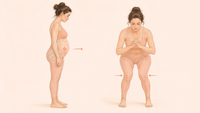
It started as a dull ache, worse going down the stairs, worse kneeling down for tummy time. Not from a fall. Not from anything I could point to. I mentioned it at a follow-up appointment, half-expecting to be told it was nothing. Instead, my doctor asked if it felt worse on stairs or when kneeling, and when I said yes, she explained something I'd never once heard of: a hormone called relaxin, released during pregnancy to loosen your ligaments for birth.
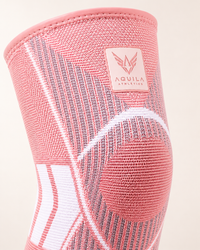
This is exactly the gap Aquila's knee stabilizer is built for — a light, breathable compression sleeve with side stabilizers and a patella pad designed to support tracking through everyday movement, discreet enough to wear under leggings or jeans all day.
See how it works →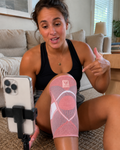
“Six weeks in, I felt fine. Then out of nowhere, my knee gave out. Turns out, it's not random at all — and once I understood why, everything changed.”— Amanda R., 12 weeks postpartum
It can stay elevated for months afterward, especially while breastfeeding — which was likely exactly why my knee felt so unstable, so suddenly, with no clear cause.
She said the usual first step was simple: some targeted stretches, and ideally some kind of compression support to help the joint feel steadier while everything settled back into place. I nodded, took some photos of her stretches it down, and told myself I'd look into it as soon as I had five free minutes. It took me longer than I'd like to admit to actually find them.
When I finally did look, I ordered the first knee sleeve that came up in a search — cheap, decent reviews, seemed simple enough. It helped, for about a day, before it started rolling down my leg every time I bent my knee to lift her out of the crib. I remember standing in my kitchen, sleeve bunched at my calf, thinking there had to be something built better than this.
That night, after she finally went down, I did what I probably should have done from the start — actually looked into knee sleeves instead of grabbing the first one that came up. That's how I found Aquila's kit: three sleeves instead of one, so I'd always have a clean one on hand, plus a resistance band, a foam roller, and two short guides tucked in. What actually caught my attention was one specific detail in the description — side stabilizers built to hold the kneecap in place, instead of just squeezing the whole leg the way mine had. That distinction alone was the reason I gave it a shot. Here's me with one of the sleeves:

After I bought it I was immediately send some free guides on how to help me with my knee and hip pain. I checked back with my doctor and she also said it was super useful, and asked me for a copy.
Now — What's actually inside the guides?
The part readers say they loved
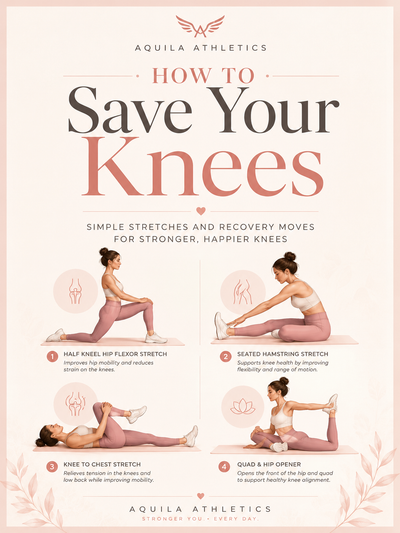
How to Save Your Knees
Top 10 Stretches for Knee Pain Relief
I assumed I'd skim it once. I still go back to it.
About a week later bundle this came in the box. Three sleeves, the resistance band, the foam roller, both guides tucked inside. The other 2 ebooks were sent to me for free over as a PDF. I unpacked it on the floor table while she napped, half-hoping, half-skeptical, and put one on that same afternoon.

I tried them on, moved around the house, and what do you know. It fits. It felt nice. It felt secure, like my feet had an extra set of armor to tackle the day.

I'm not going to pretend one kit fixed everything. Recovery is bigger than that. But I sure darn know that I need to take care of myself so that I can also take care of my baby.
P.S. I'll be trying some stretches with the foam roller. But if postpartum knee pain has been part of your last few months too, this is the exact kit I ended up with.

Aquila knee brace — light, breathable compression sleeve with side stabilizers and a patella pad designed to support tracking through everyday movement, discreet enough to wear under leggings or jeans all day.
See how it works →How other moms feel about it.

I didn't expect a knee sleeve to be the thing that got me back on the floor with my daughter, but here we are.

Sized up like the guide suggested and it fit perfectly. Wish I'd found this sooner.

Genuinely didn't expect to use the stretch guide as much as I have. It's become part of my morning routine.

Stairs stopped being scary within about two weeks of wearing it daily.
A few things readers ask us
Is this safe to wear while breastfeeding?
Yes — it's a compression garment, not a medication, so it doesn't interact with breastfeeding at all.
How long until I notice a difference?
Most readers tell us they feel the stability difference the first time they wear it. Reduced ache with regular wear typically builds over 1-2 weeks.
Do I still need to do the stretches if I wear the sleeve?
We'd recommend both — the sleeve supports the joint day to day, while the stretches help address the underlying muscle imbalance over time.
What if it doesn't fit right?
Our sizing guide walks you through measuring at home, and if it's still not right, our team will help you exchange it.
Before you go — here's the short version.
- Postpartum knee pain is common, and it has a real physical cause.
- Stretches help, but often need backup while your body catches up.
- That's exactly what this kit was built for.