Press Feature
Press Feature
Press Feature
The Wellness Edit
Postpartum RecoveryWhy Your Knees Suddenly Hurt Postpartum (And What Actually Helps)
It's not injury. It's not in your head. Here's what's actually happening.
 By Sarah Mitchell, Contributing Writer
•
8 min read
By Sarah Mitchell, Contributing Writer
•
8 min read

"It's not injury. It's not in your head. Here's what's actually happening."
If you had a smooth, pain-free pregnancy and now — weeks or months later — your knee is suddenly aching for no clear reason, you're not imagining it, and you're not alone. This specific kind of knee pain has a name (patellofemoral pain syndrome, often called "runner's knee"), and it's surprisingly common in postpartum women, even those who never ran a day in their life.
It's Not Injury — It's Relaxin
During pregnancy, your body released a hormone called relaxin to loosen ligaments and widen the pelvis for birth. Here's the part nobody tells you: relaxin doesn't just switch off the day your baby arrives. It can stay elevated for months postpartum, especially if you're breastfeeding — which means your joints, including your knees, can stay looser than usual long after delivery. That looseness can let the kneecap drift slightly out of its natural groove during ordinary movement.

Your Center of Gravity Hasn't Fully Reset
Nine months of carrying a baby forward shifts your posture, stretches your abdominal wall, and can leave your glutes underactive. Postpartum, that often shows up as your knees caving slightly inward when you squat, bend, or lift — small on its own, but repeated hundreds of times a day, it adds real strain to the joint.

The "Mom Squat" Is Doing More Than You Think
Picking up a car seat. Grabbing a toy off the floor. Lifting baby out of the crib. These are unweighted, repetitive squats and lunges — done constantly, often with tired form, often without you ever thinking of them as exercise. Your knees, though, are absolutely counting the reps.

Try this: When picking baby up or standing from a low chair, consciously push your knees outward instead of letting them fall inward.
Feeding Sessions Are Quietly Compressing Your Kneecap
Long nursing or rocking sessions often mean your knees sit bent at 90 degrees for extended stretches. That static position creates sustained pressure directly under the kneecap — sometimes called the "theater sign," because it's the same ache you'd get sitting through a long movie.

Try this: Use a footstool or nursing pillow to keep your feet flat and your legs slightly elevated, avoiding that tight, closed knee angle for long stretches.
Compression Support Can Improve How Your Knee "Tracks"
This is where a lot of moms find real relief. A compression knee sleeve doesn't just add warmth — it improves proprioception, which is your brain's real-time awareness of where your joint is in space. With better proprioception, your knee tracks more accurately during the hundreds of daily bends and lifts motherhood demands, instead of drifting and catching on the same worn spot.
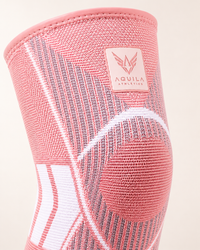
This is exactly the gap Aquila's knee stabilizer is built for — a light, breathable compression sleeve with side stabilizers and a patella pad designed to support tracking through everyday movement, discreet enough to wear under leggings or jeans all day.
See how it works →
“Six weeks in, I felt fine. Then out of nowhere, my knee gave out. Turns out, it's not random at all — and once I understood why, everything changed.”— Amanda R., 12 weeks postpartum
Rebuilding Your Glutes Is the Long-Term Fix
Since knee valgus (that inward cave) often traces back to underactive glutes, simple activation moves make a real difference over time. None of these require a gym or more than a few free minutes — ideal for fitting in during a nap window.

Strengthening your knees with
Pregnancy compromises your core and pelvic floor, and skipping straight to lower-body strength work without rebuilding that foundation first can slow your recovery. Simple 360-degree diaphragmatic breathing — expanding your ribs in all directions as you inhale — helps re-establish that base before progressing further.
Strengthen the Quad Without Aggravating the Joint
Deep bends can aggravate an already irritated kneecap, so postpartum-safe strength work usually avoids them. These build the muscle support your knee needs without the deep flexion that tends to trigger the pain in the first place.

Ice Still Works — Use It Strategically
After a higher-activity stretch (a longer walk, a busy day of lifting and carrying), 10–15 minutes of ice on the knee helps calm localized inflammation. Simple, but easy to forget when you're juggling a newborn.
Movement Is Still the Goal — Just the Right Kind
Complete rest tends to make this worse, not better, since the muscles supporting the knee need consistent, gentle activation to recover. The goal isn't to stop moving — it's to lower the pain barrier enough that you can keep moving: through tummy time, through stairs, through simply standing up from the couch without bracing yourself first.
A quick note: if your knee pain is severe, sudden, or involves swelling, instability, or a feeling that your kneecap is shifting out of place, it's worth getting evaluated by a doctor or physical therapist before self-managing — this article is meant to support your recovery, not replace medical care.
Now — What's actually inside the guides?
The part readers say they loved
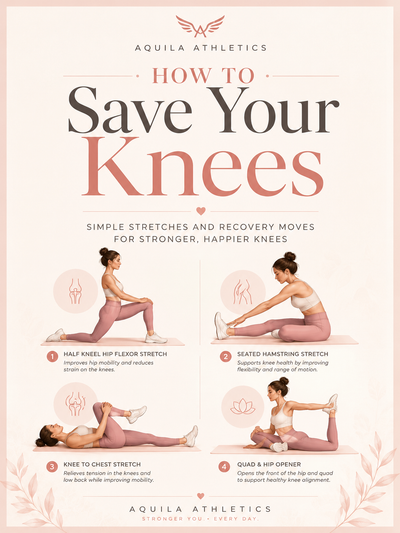
How to Save Your Knees
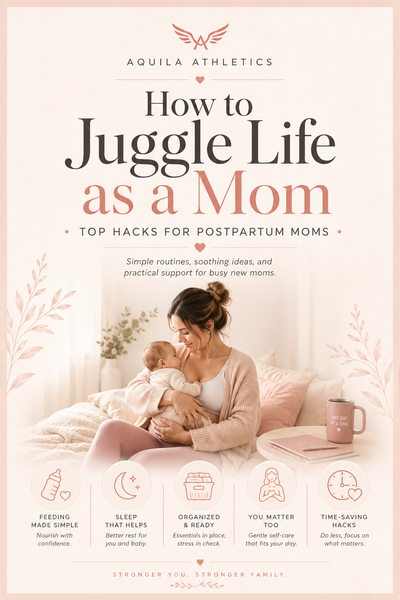
Top 10 Stretches for Knee Pain Relief
I assumed I'd skim it once. I still go back to it.
The fastest way to start feeling relief today.
Understanding which sleeve is right for your unique situation matters — that's why our guide was designed to support you through every step of the healing process.

Other moms going through the same thing.

I didn't expect a knee sleeve to be the thing that got me back on the floor with my daughter, but here we are.

Sized up like the guide suggested and it fit perfectly. Wish I'd found this sooner.

Genuinely didn't expect to use the stretch guide as much as I have. It's become part of my morning routine.

Stairs stopped being scary within about two weeks of wearing it daily.
A few things readers ask us
Is this safe to wear while breastfeeding?
Yes — it's a compression garment, not a medication, so it doesn't interact with breastfeeding at all.
How long until I notice a difference?
Most readers tell us they feel the stability difference the first time they wear it. Reduced ache with regular wear typically builds over 1-2 weeks.
Do I still need to do the stretches if I wear the sleeve?
We'd recommend both — the sleeve supports the joint day to day, while the stretches help address the underlying muscle imbalance over time.
What if it doesn't fit right?
Our sizing guide walks you through measuring at home, and if it's still not right, our team will help you exchange it.
Before you go — here's the short version.
- Postpartum knee pain is common, and it has a real physical cause.
- Stretches help, but often need backup while your body catches up.
- That's exactly what this kit was built for.